


If you searched ekusupedexia trying to figure out what it means, you’ve probably already noticed the results don’t agree on much. One article calls it a business strategy framework. Another calls it internet slang for a feeling of confused curiosity. A third, and this is the one worth paying real attention to, describes it as a diagnosable learning and attention disorder, complete with symptoms, causes, and a clinical assessment process. None of that adds up, and it’s worth understanding exactly why before you take any of it at face value.
I went through what’s currently published about this term, and there’s a genuinely important distinction to make here, not just between real and fake, but between fake-and-harmless and fake-in-a-way-that-could-actually-mislead-someone-about-their-health.
What Ekusupedexia Actually Is
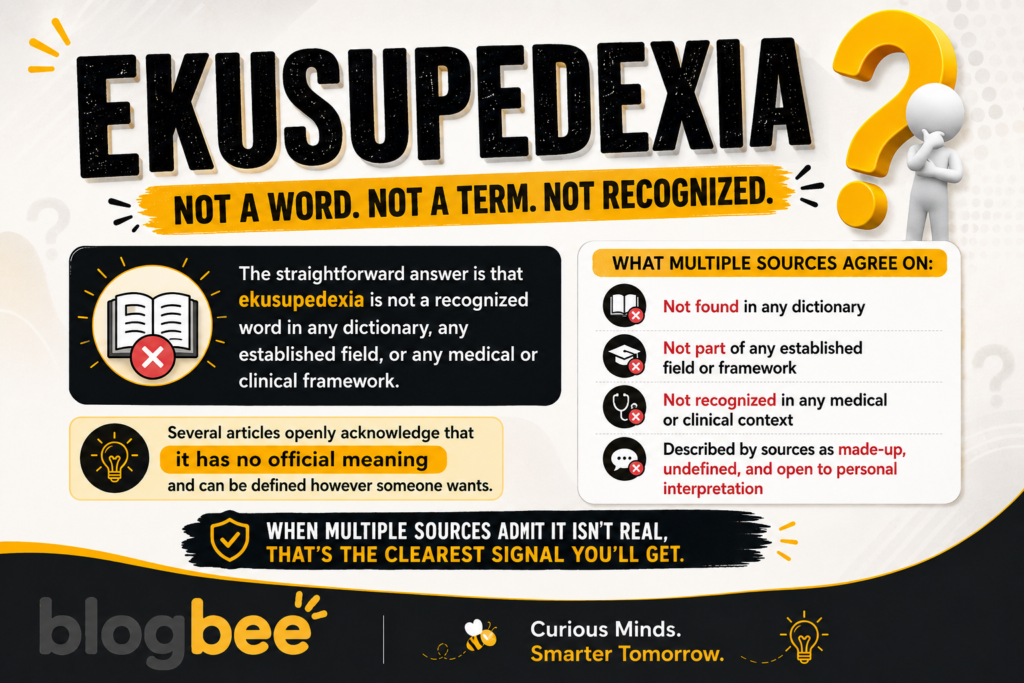
The straightforward answer is that ekusupedexia is not a recognized word in any dictionary, any established field, or any medical or clinical framework. Several of the articles using the term openly acknowledge this themselves, describing it as not coming from common language, having no official meaning, and being something people are free to define however they like. When multiple sources publishing content about a term admit upfront that it isn’t a real, established word, that’s about as clear a signal as you’ll get.
What you’re looking at instead is a term that appears to have been invented and then written about from several completely different angles, each treating it as though it were a legitimate, pre-existing concept. That’s a specific and increasingly common pattern online, a made-up word gets seeded across a handful of content sites, each one inventing its own explanation, and search engines end up surfacing a pile of confident-sounding articles about something that never existed in the first place.
The reason this matters beyond simple curiosity is that the different invented meanings aren’t equally harmless. A vague description calling it “trendy internet slang for feeling curious and confused” is essentially meaningless filler content. A description presenting it as a real, diagnosable condition affecting reading, memory, and attention is a completely different situation, and that’s the version that deserves the most scrutiny.
The Fabricated Business Buzzword Version
One version of ekusupedexia frames it as a strategic or organizational concept, described with phrases like “structured thinking with adaptive problem-solving” and built on principles of “observation, interpretation, adaptation, and execution.” Read closely, though, this description doesn’t actually explain anything concrete. It never names a founder, a research paper, a company that uses it, or a single specific example of the framework being applied anywhere.
This kind of content follows a recognizable formula, dense with abstract, professional-sounding language, dropping in real adjacent buzzwords like “digital transformation,” “business agility,” and “systems thinking,” without ever connecting the invented term to anything you could actually go verify. It reads like a legitimate strategy framework at a glance, but there’s nothing underneath the vocabulary once you look for a real source.
This version is largely harmless in the sense that nobody is likely to make a risky decision based on it, but it’s still worth recognizing for what it is, content generated to fill space around an invented keyword rather than genuine analysis of a real business concept. If you’re researching actual strategic frameworks, this article won’t teach you anything real, no matter how polished the language sounds.
Why the Fake Medical Condition Framing Is a Real Problem
This is the part worth slowing down for. At least one source describes ekusupedexia as a genuine learning and attention disorder, claiming it affects how people process, store, and use information, and listing specific symptoms across different age groups, delayed language in young children, slow reading and copying errors in school-age kids, avoidance of complex reading in teenagers, and slow information processing in adults. It goes further, describing supposed causes like differences in brain networks, genetic factors, and premature birth, and even outlines a fake clinical diagnosis process involving psychologists and speech-language pathologists.
None of this reflects any recognized diagnosis in psychology, neurology, or education. Real learning and attention differences absolutely exist and are well documented, conditions like dyslexia, ADHD, specific learning disorders, and auditory or language processing disorders are established, researched, and diagnosed through legitimate clinical criteria. Ekusupedexia is not one of them. It appears to have been constructed by borrowing the general shape and vocabulary of real learning-disorder content, symptom lists, risk factors, intervention strategies, without any actual clinical basis behind it.
This matters because someone genuinely worried about their child’s reading progress, or their own difficulty with memory and focus, could stumble onto that article and think they’ve found a name for what they’re experiencing. At best, that wastes time. At worst, it delays someone from seeking an actual evaluation for a real, treatable condition, because they believe they’ve already identified the issue based on fabricated information dressed up to look clinical.
The Vague Internet Slang Version
A third version treats ekusupedexia as an emerging piece of internet culture, something used to describe a mix of confusion and curiosity, or simply an interesting-sounding invented word suited for usernames, branding, or creative projects. This version is more openly speculative than the other two, repeatedly noting that the word has no fixed meaning and that people are free to interpret it however they want.
Unlike the fake medical framing, this version isn’t really claiming to be factual information at all, it’s closer to acknowledging outright that the word is a blank canvas. That’s a meaningfully different kind of content, since it’s not pretending to document something real, it’s openly discussing the phenomenon of invented internet words in general terms, even if ekusupedexia itself doesn’t appear to have any genuine grassroots usage behind it either.
Even so, this version still contributes to the overall confusion, since a reader who encounters this article after the business-framework or medical-disorder versions has no easy way to know which “definition” is supposed to be the real one. That’s the core problem across all of this content, not that any single article is dangerous on its own necessarily, but that the pile of contradictory explanations makes it genuinely hard for anyone to tell fact from invention without doing the kind of digging this article just did.
How to Recognize a Fabricated Term Like This
The clearest signal is direct contradiction between top-ranking sources on the basic category of the thing being described. A business framework, an internet slang term, and a clinical diagnosis are not three interpretations of the same concept, they’re three unrelated categories entirely, and no real word or concept legitimately spans all three without any source acknowledging the overlap or explaining the connection.
A second signal is the presence of confident, specific-sounding claims with nothing to verify them against. The fake medical version is the clearest example, it lists symptoms, causes, and a diagnostic process with the same tone and structure you’d expect from a legitimate health resource, but it never references an actual study, a named researcher, a diagnostic manual, or a professional organization that recognizes the condition. Real clinical information almost always points to something checkable, a specific diagnostic criteria set, a named body of research, or an established professional body.
A third signal, and one worth remembering for cases beyond this specific word, is when the sources themselves hedge or openly admit the term has no fixed or official meaning while simultaneously writing thousands of words explaining what it supposedly means. That contradiction, insisting a word is undefined while confidently defining it anyway, is a strong tell that you’re looking at content built around a keyword rather than a real, established idea.
Where to Go for Real Information Instead
If you or someone you know is genuinely dealing with reading difficulties, memory challenges, or trouble with attention and task planning, that concern is worth taking seriously, just not through a fabricated term. Legitimate starting points include a conversation with a pediatrician, general practitioner, or school counselor, who can refer you to a qualified psychologist, speech-language pathologist, or educational specialist for a real evaluation.
Established, well-documented conditions like dyslexia, ADHD, and specific learning disorders have decades of research, recognized diagnostic criteria, and dedicated professional organizations behind them. Searching for information through recognized health institutions or established learning-disability organizations will get you accurate, actionable information, rather than symptom lists borrowed from real conditions and reattached to an invented name.
If what drew you to this search was genuine curiosity about an unusual word rather than a health concern, that’s a completely different and lower-stakes situation, and hopefully this breakdown answers that curiosity honestly, it’s an invented term with no consistent meaning, being explained in incompatible ways by content that isn’t describing anything real.
Frequently Asked Questions
Is ekusupedexia a real word? No, ekusupedexia doesn’t appear in any dictionary or established field, and several of the sources using it openly acknowledge that it has no official or fixed meaning.
Is ekusupedexia a real medical condition? No, despite one source describing ekusupedexia with symptom lists, causes, and a diagnostic process resembling real clinical content, there is no recognized diagnosis by this name in psychology, neurology, or education. Real learning and attention conditions, such as dyslexia and ADHD, are separately documented and diagnosed.
Why do different websites describe ekusupedexia so differently? The inconsistency, ranging from a business framework to internet slang to a fabricated medical condition, suggests the term was invented and then written about independently by different sites rather than describing one real, established concept.
Could I actually have the condition described as ekusupedexia? No, since ekusupedexia isn’t a recognized diagnosis. If you’re experiencing real difficulties with reading, memory, or attention, it’s worth seeking evaluation for an actual, established condition through a qualified professional rather than researching this term further.
Is it harmful to read content about ekusupedexia? Reading about ekusupedexia isn’t harmful on its own, but treating the fabricated medical version as accurate information could delay someone from seeking a legitimate evaluation for a real condition, which is why it’s worth recognizing this content for what ekusupedexia is.
How can I tell if a trending term is fabricated? Look for contradictions in how different sources define its basic category, check whether any claims point to a verifiable source like a named study or recognized professional body, and be skeptical when a term is described as having no fixed meaning while still being confidently explained at length.
You May Also Read: What Does OMS Mean in Text

